

Sensorized Environment

A new infrastructure for AI-ready buildings

A new infrastructure for AI-ready buildings

Real-time data is the key to AI-based technologies in buildings. That’s why we have further developed our modular building data model into the Sensorized Environment:
This new infrastructure connects the building with its digital twin and ensures seamless interaction between building, machine, process and people.

  • Integrated: Extension of established BIM data structures
  • Live: Real-time data for better decisions by humans and AI systems.
  • Future-proof: The foundation for integrating current and new AI technologies.
  • Areas of applicaton: Airports, laboratorys, hospitals, industry and offices

a strategic partnership with

What is a sensorized environment?

What is a Sensorized Environment?

A sensorized environment is the next evolutionary stage of the smart building. It combines sensor technology, network integration, digital twins, and analysis models to control processes in real time and act proactively.
This also includes structural adjustments to the building in order to optimally integrate sensor technology and prepare the environment both technically and structurally.
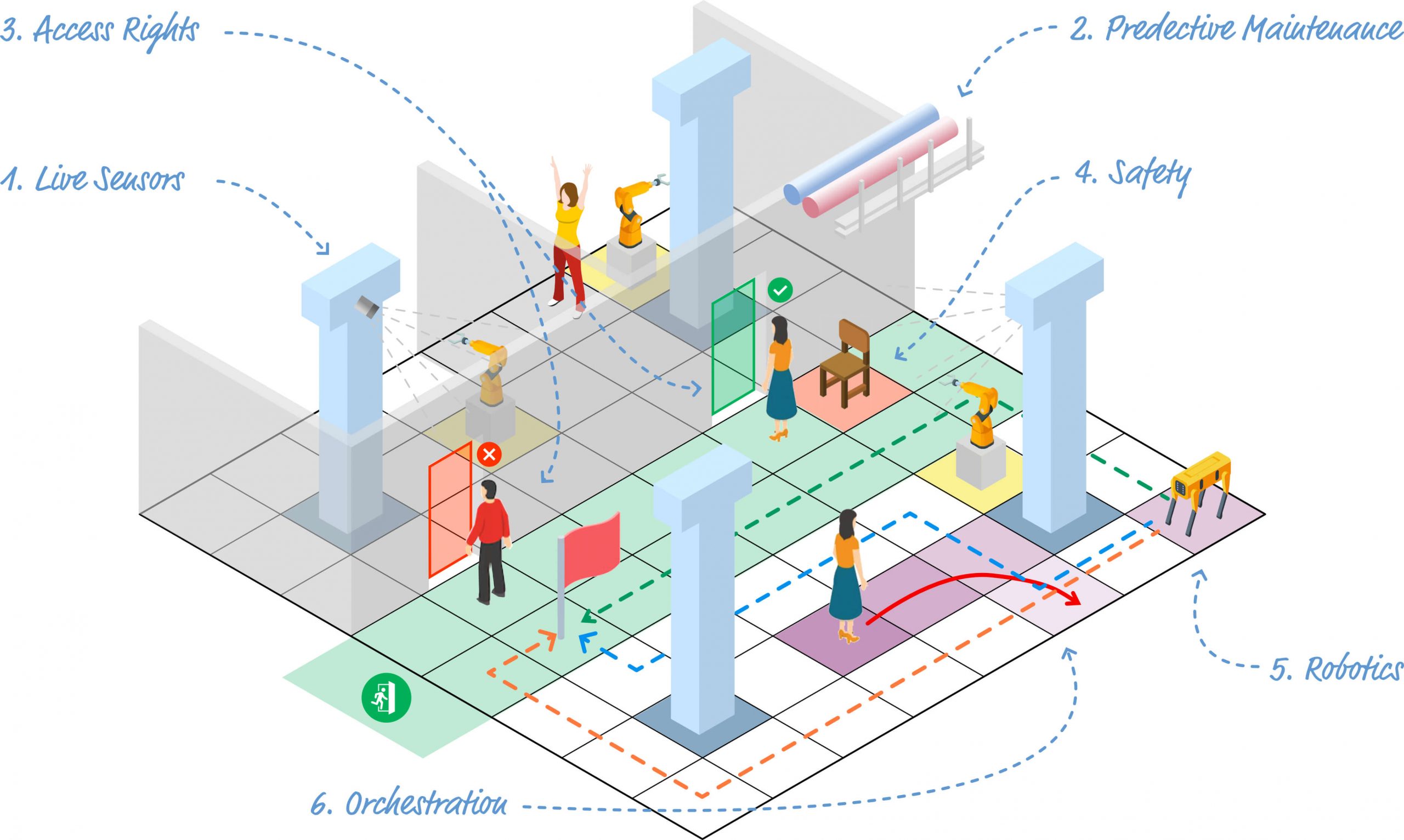
The sensorized environment describes an intelligent, self-optimizing environment that not only collects data, but also interprets it, learns from it, and independently derives actions.

Through the targeted combination of powerful sensor technology, seamless network integration, digital twins, and simulation-based analysis models, processes can be tracked in real time and controlled automatically. This creates an infrastructure that acts proactively and responds to sudden changes.

It is essential that the development of a sensorized environment does not only include digital components, but also structural implementations and adaptations. These physical interventions ensure that the sensor technology is optimally integrated and that the environment is prepared, both technically and structurally, for the requirements of an intelligent, networked infrastructure.

  1. Live sensors: Live sensors such as LiDAR or cameras capture activities within the building.
  2. Predictive maintenance: Sensors provide operational data and predict maintenance needs at an early stage.
  3. Permissions: Access permissions in sensitive areas are checked in real time.
  4. Safety: Hazards, such as blocked escape routes, are detected.
  5. Robotics: Cognitive robots are trained using the data provided.
  6. Orchestration: All actors (robots, people, machines) are autonomously coordinated.

Central component of the sensorised environment

Real-time capable digital twin

Real-time capable digital twin
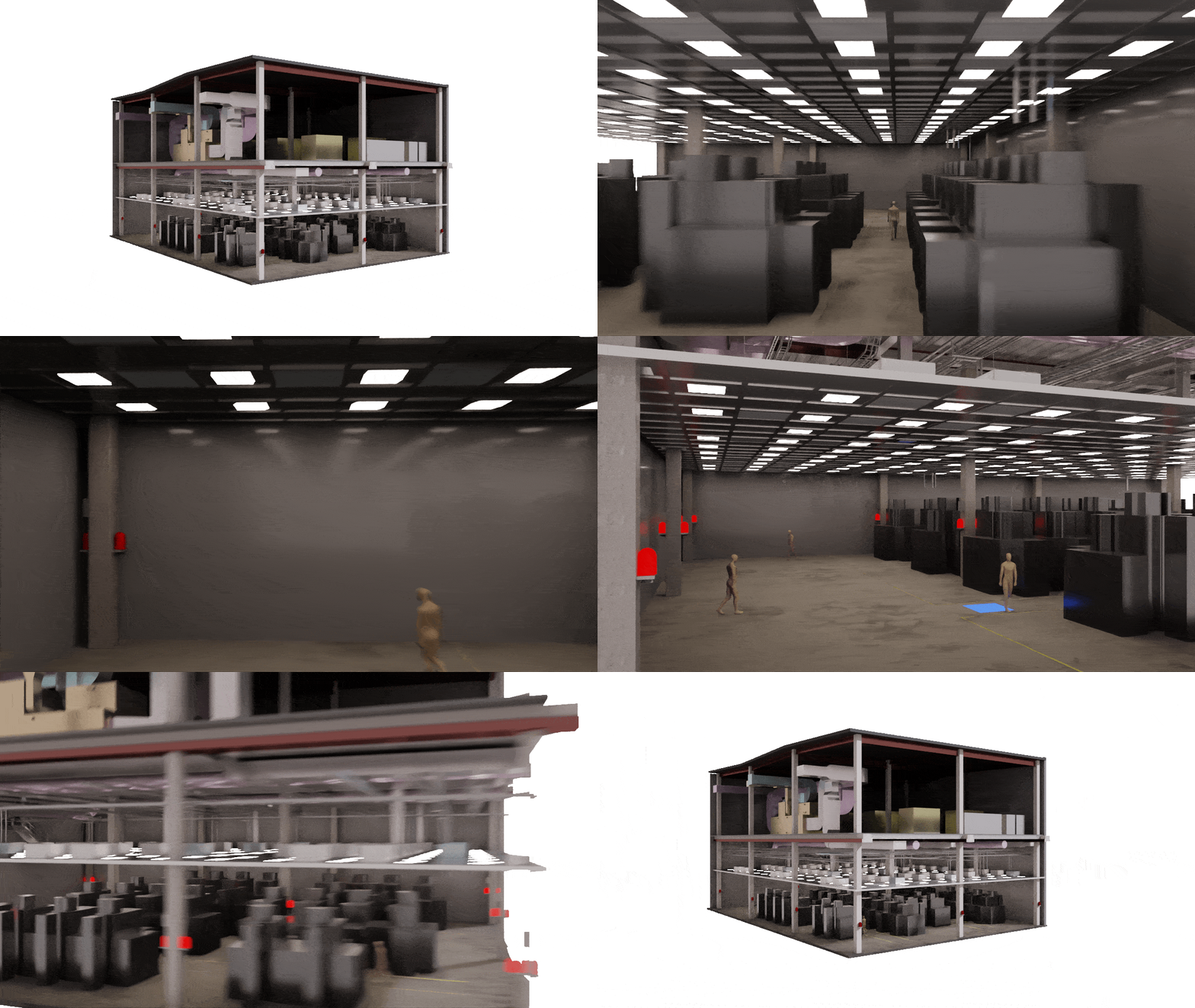
Digital twin battery factory (NVIDIA Omniverse)

A real-time digital twin not only maps the building, but also all the dynamic processes within it. It is the central hub for control and analysis, connecting the physical and digital worlds into a continuously synchronised environment.

The digital twin goes far beyond traditional BIM models. It integrates moving objects such as people, machines and robots, as well as conditions such as temperature and lighting. In live operation, it actively responds to changes and controls building technology. In planning, it is used to simulate complex scenarios – for example, for training robots or emergency evacuations.
This makes it a central component of a sensorised environment: a data-driven reference environment in which conditions are visualised in real time, scenarios are simulated realistically and decisions are made automatically.

AI, robotics and networking are also fundamentally changing buildings – those who act now will secure their future viability.

AI, robotics and networking are also fundamentally changing buildings – those who act now will secure their future viability.

First step towards a sensorized environment

The Readiness Check

We provide clarity for your next steps: The Readiness Check evaluates your current infrastructure and shows you how to optimally integrate sensor technology, networks and digital twins. This gives you a sound basis for investment and a roadmap for implementation.

Service modules

The Readiness Check is your strategic entry point into the world of the sensorised environment. Based on your individual use cases, we analyse all relevant components:

  • Building and space structures – Are structural adjustments necessary?
  • Network and IT infrastructure – Is the basis for real-time data and secure communication in place?
  • Sensors and systems – Which technologies are available, and which need to be added?
  • Data basis for the digital twin – How can data be integrated consistently and usefully?

In addition, we develop a concept for data security and compliance, tailored to legal requirements and industry-specific requirements.
The results are compiled in a technical requirements profile and a practical guide. This defines specific measures, investment priorities and a roadmap for the gradual implementation of your sensorised environment.

Your benefits

  • Planning reliability: You know exactly where you stand and what steps are necessary.
  • Investment protection: Clear prioritisation helps you avoid bad investments.
  • Strategic basis for decision: From structural upgrades to digital implementation, you receive a robust roadmap for sustainable digitalisation.
  • Future-proofing: You lay the foundation for the use of robotics, AI and digital twin technologies.

Your contact:

Martin Manegold

Dipl.-Ing.
Head of Design Technology

+49 721 266756 10

FAQ

Technology & function

A Sensorized Environment connects various sensors and systems within a building in order to capture, analyze and respond to data in real time. Its functioning can be divided into three steps:

  • Acquisition of data:
    Sensors measure relevant parameters such as movement, temperature, the position of objects or the status of equipment. Different technologies are used for this – from point cloud sensors to IoT devices.
  • Data processing:
    The captured data is brought together, filtered and interpreted via a central platform. This creates a digital representation of the building that can also interact with other systems such as smart building components or robotics.
  • Response and integration:
    On the basis of the evaluated information, processes can be automated or optimized – for example by adjusting security zones, controlling people flows or supporting robots and AR/VR applications.

The goal: more transparency, safety and efficiency through an intelligent, connected environment.

Yes, a Sensorized Environment is based on technologies that have proven themselves over many years. What is new is the way these components are networked and used: capturing and controlling processes in the building in real time.

The sensors used are established technology – the innovation lies in their intelligent combination and integration. This creates new possibilities, especially with regard to the growing demands of robotics. But numerous use cases outside robotics also generate tangible added value, often with only minimal effort.

Insight is the first step toward improvement: those who continuously monitor their building and the processes taking place within it can take targeted action to make energy consumption and the use of resources more efficient.

Examples of the contribution to sustainability:

  • Creating transparency: real-time data on occupancy, lighting, temperature, and system status enables precise analysis of energy consumption.
  • Demand-based control: lighting, heating, cooling, and ventilation can be automatically adjusted – only where they are actually needed.
  • Avoiding idle operation: sensors detect unused rooms or devices and switch them off before unnecessary energy is consumed.
  • Process optimization: by networking building technology, processes can be made more efficient, e.g. through intelligent coupling of access control and climate control.
  • Long-term planning: the collected data serves as a basis for sustainable investments and CO₂ reduction strategies.

A Sensorized Environment not only makes buildings smarter, but also more resource-efficient – an important step toward climate neutrality.

The sensorized environment creates the foundation for the efficient use of autonomous robotics and intelligent automation. Over the coming years, this technology will be particularly relevant in two main categories:

1. Areas with high automation potential (logistics and internal processes)

Here, a sensorized environment enables precise control, safety, and optimized workflows:

  • Retail: Automated movement of goods, inventory control, intelligent management of customer flows.
  • Industry and manufacturing: Optimization of material flows, adaptive safety zones, support for collaborative robotics.
  • Healthcare (hospitals): Automated floor trolleys, efficient loading and transport of materials.

2. Areas with high public traffic

In these environments, the technology ensures safety, orientation, and smooth operations:

  • Airports and train stations: Analysis of passenger flows, fast emergency response, baggage tracking.
  • Museums and event venues: Visitor guidance, adaptive safety zones, integration of AR/VR for planning and experience.

Conclusion: Wherever complex movement and safety requirements exist, a sensorized environment forms the basis for intelligent automation and future-proof processes.

Use cases & benefits

A robot primarily perceives its surroundings through sensors within its own field of view and must make decisions based on this limited information. A sensorized environment extends this view to all processes taking place in the building:

  • Access to global information: The robot receives data from the entire environment, not just from its immediate line of sight.
  • Smarter decisions: Context information such as people flows, obstacles, or machine status can be incorporated into its decision-making logic.
  • Increased efficiency: The sensorized environment filters relevant information and provides it to the robot in a structured form. As a result, the robot no longer has to interpret large volumes of raw data on its own.
  • Resource conservation: Reduced computational effort and lower server capacity requirements lead to lower energy consumption and faster response times.

A robot can now “think” not only locally but globally – and thus operate more safely, efficiently, and with optimized energy usage.

Yes, there are numerous use cases beyond robotics that deliver high added value – often with manageable effort and major impact.

Examples include:

  • Real-time monitoring of escape routes to increase safety.
  • Early detection of component failures to minimize operational disruptions.
  • Analysis and control of people flows for optimized building utilization.
  • Object localization to detect deviations from designated storage locations.
  • Adaptive safety and work zones to improve safety during maintenance activities.
  • Tracking of non-autonomous vehicles such as forklifts to prevent accidents and congestion.
  • Rapid response to emergency scenarios such as fire, evacuation, or earthquakes.
  • A foundation for augmented reality applications, e.g.:
    Assembly assistance, Visual status reports of equipment
  • Support for facility management

A sensorized environment therefore provides, even without robotics, a foundation for greater safety, efficiency, and digital connectivity.

Data protection & security

Yes, a sensorized environment can be designed in such a way that it complies with applicable data protection regulations. Taking these requirements into account as early as the planning phase is a key quality feature for us. Our guiding principle is:

  • Principle of data minimization – collect only the data that is absolutely necessary to achieve the intended purpose.
  • Storage limitation – store only what is necessary.

Yes, a sensorized environment can be designed in such a way that data security is ensured. Wherever sensitive data is processed, appropriate protective measures are indispensable. At the same time, risks can be minimized by primarily using sensors that only provide highly abstracted information—for example, point clouds instead of image data. No identifiable features are captured, only individual measurement points. In addition, technical solutions for anonymization can be integrated.

Individual requirements, technical possibilities, and potential risks are comprehensively taken into account in our Readiness Check.

No, in a sensorized environment, the storage of personal data is generally not required. Most sensors collect only technical measurements such as temperature, movement, or point clouds that do not contain any direct identifiers. If, in certain use cases, personal data is unavoidable (e.g. for access control), the principle of data minimization applies:

  • Only the strictly necessary information is processed.
  • Data is anonymized or pseudonymized to protect privacy.

Implementation

Yes, Sensorized Environments can also be retrofitted in existing buildings. This requires a thorough analysis of the building to determine which measures – both structural and related to the IT infrastructure – are necessary and economically viable.

That is exactly what our readiness check provides: it establishes a sound basis for decision-making founded on technical expertise. One thing is already clear: the optimal solution always depends on the specific building and use case.

Yes, a sensorized environment can be implemented gradually. The setup can be modular, so that individual areas or functions are equipped first and additional components are added later.

Advantages of a gradual approach:

  • Flexibility: adaptation to budget, timeline, and priorities.
  • Lower initial investment: start with the most important use cases and expand later.
  • Learning effects: early insights from pilot areas feed into further planning.
  • Scalability: the architecture and IT infrastructure are designed so that later extensions are easily possible.

A readiness check helps define the right sequence and the most economically sensible steps.

Strategy

Digital transformation is turning buildings into active players. They must be prepared for this.

  • Technological tipping point: Sensor technology, IoT and digital platforms are mature and economically viable. Robotics is developing rapidly – buildings need to be ready to integrate these technologies efficiently.
  • Rising demands: Energy efficiency, security and flexibility are now key criteria for buildings. Real-time data is the key to meeting these requirements.
  • Competitive advantage: Those who invest now lay the foundation for smart processes, cost reduction and future-proof business models.

digitales bauen is the ideal partner for the implementation of a Sensorized Environment because we combine traditional construction expertise with digital planning and technological integration. With over 25 years of experience in modular planning and, as part of Drees & Sommer, we have access to a strong network and extensive expertise.
We not only master the fundamentals of construction, but also key technologies such as sensors, IoT, digital twins, AR/VR applications and robotics integration.

  • Holistic approach: digitales bauen combines traditional construction expertise with digital planning and technological integration.
  • Experience & expertise: Over 20 years of experience in modular planning and, since 2020, part of Drees & Sommer – with access to a strong network and innovative strength.
  • Technological competence: Know-how in sensors, digital twins, AR/VR and robotics integration.
  • Tailored solutions: No standard products – we develop customized concepts based on readiness checks and economic feasibility.
  • Detailed knowledge of the real potential: As a strategic partner of Neura Robotics and NVIDIA, we know the current and upcoming technological possibilities.

digital planning, constructing
and operating

digitales bauen
Augartenstrasse 1
76137 Karlsruhe
Germany
+49 721 266756 10
info@digitales-bauen.de

© digitales bauen 2025
Legal Notice
Privacy Policy
